
Most discussions about preparing for a market crash begin inside the portfolio. Investors think about diversification, bonds, cash allocations, defensive assets or the percentage decline they believe they can tolerate. These are legitimate questions, but they overlook something more fundamental. Your ability to live through a drawdown depends not only on what you own, but also on the financial structure surrounding what you own.
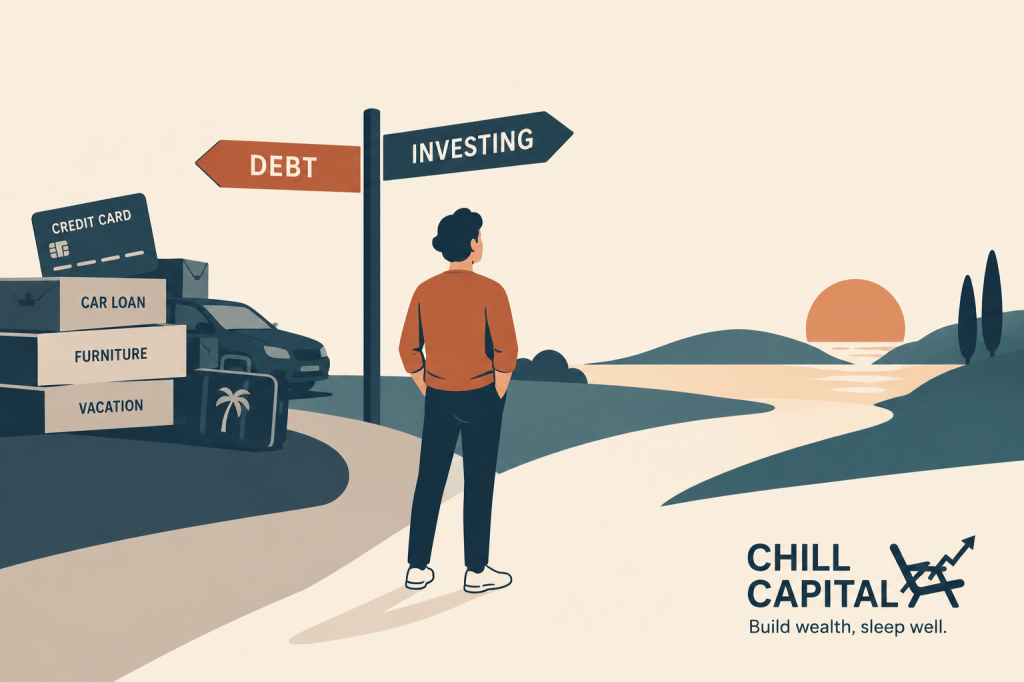
This is where debt becomes relevant. Not necessarily a mortgage, which belongs to a broader discussion about housing, leverage and long-term financing, but the ordinary consumer debt that quietly becomes part of everyday life: credit card balances, car loans, furniture bought in installments, financed electronics and even vacations paid with money that has not yet been earned. Each individual payment may appear manageable. The problem becomes visible only when they are considered together. They create a layer of obligations that your future income must satisfy before that income is actually yours.
Before thinking seriously about investing, there is therefore a simpler question worth asking: how much of your future income have you already promised to the past?
For me, reducing these obligations had an effect that went beyond the obvious savings on interest. It increased the amount I could invest, certainly, but it also changed how I experienced investing itself. Market declines became easier to accept because less of my monthly income was already committed elsewhere. The portfolio could fluctuate without immediately colliding with a complicated structure of payments and obligations. What initially looked like a personal-finance decision turned out to be part of my investment strategy.
The Portfolio Does Not Exist in Isolation
Imagine two investors with identical portfolios, identical salaries and identical investment knowledge. Both experience a 30% market decline.
The first has a car payment, revolving credit card debt and several purchases being paid in installments. A significant portion of each month’s income is already committed before groceries, utilities and ordinary living expenses are considered. The second has none of these obligations. Their investment portfolios may be identical, but their experience of the crash probably will not be.
The difference is not risk tolerance in the conventional sense. It is financial flexibility.
When markets fall, the second investor has more room to do nothing. That sounds trivial, but doing nothing during a serious drawdown is one of the hardest things investing asks of us. The ability to wait is much easier to discuss when markets are rising than when years of accumulated gains disappear from a brokerage account while bills continue arriving with perfect regularity.
Consumer debt reduces that ability to wait because debt transforms future income into a contractual obligation. When you finance a car today, part of the salary you will receive six months from now already has a destination. The same is true of a credit card balance or a sofa divided into monthly installments. The financing may even carry a low interest rate, but the economic consequence extends beyond the interest rate. Your future cash flow has become less flexible.
This is why comparing the expected return of an investment with the interest rate on a loan can sometimes miss the larger point. Mathematically, borrowing at a low rate while investing money that might earn a higher return can look rational. But the expected return is uncertain while the payment is not. The market does not know that your car payment is due next Tuesday.
Removing consumer debt does something that cannot easily be represented by a return calculation: it increases the distance between what you earn and what you are required to spend. That distance is financial slack, and financial slack has considerable value during periods when markets, employment or life itself become less predictable.
There are obvious exceptions. Sometimes financing is not a lifestyle choice but a practical necessity. Someone who needs a car to reach work and does not have enough cash to buy one may reasonably finance it. Refusing every form of debt regardless of circumstances can become as rigid as using debt carelessly. The useful distinction is not between people who borrow and people who never borrow. It is between debt that solves a genuine constraint and debt that routinely allows consumption to arrive before the money required to pay for it.
That distinction gradually changes purchasing decisions. Instead of asking whether the monthly payment is affordable, the question becomes whether the purchase itself is affordable. If the cash is available, the decision can be made. If it is not, waiting becomes the default unless there is a compelling reason not to.
The change seems small, but repeated over years it can reshape a financial life.
Debt Changes the Experience of Risk
Investors often describe risk as volatility, maximum drawdown or permanent loss of capital. Those definitions are useful for analysing portfolios, but personal risk has another dimension: the possibility of needing money at the wrong moment.
A 40% decline in equities is unpleasant for almost everyone. But if the investor has stable income, manageable expenses, sufficient liquidity and few financial obligations, the decline can remain largely an event on a screen. The investor may dislike it, but nothing necessarily requires action.
Add substantial monthly debt payments and the same decline can feel different. The portfolio is falling while the household still needs a certain amount of cash every month simply to remain current. If employment becomes uncertain at the same time — something that can happen during severe economic downturns — the psychological connection between falling investments and immediate financial security becomes much stronger.
This helps explain why preparing for a crash cannot be reduced to finding the perfect asset allocation. A portfolio can be beautifully diversified and still belong to someone whose personal balance sheet leaves very little room for error.
Eliminating consumer debt improved my own ability to invest partly because more money became available, but the more important effect was psychological. Money transferred to the portfolio felt more genuinely long term. I was less likely to look at invested capital as money that might soon be required to support commitments elsewhere. A drawdown remained uncomfortable, but it became easier to separate temporary market losses from the functioning of everyday life.
That separation matters.
There is a tendency in investing to search for psychological solutions to structural problems. We tell ourselves that we need more discipline, stronger conviction or a greater tolerance for volatility. Sometimes what we actually need is a financial structure that demands less discipline from us.
An investor with low fixed obligations does not necessarily possess superior emotional control. They may simply have arranged their finances so that market volatility has fewer opportunities to interfere with everyday decisions. Instead of trying to become fearless during a crash, they have reduced the number of things that can turn fear into forced action.
The same logic applies before the crash arrives. When income is not absorbed by payments on yesterday’s consumption, new savings can continue flowing toward investments. Market declines can even become periods when the investor is able to purchase more assets at lower prices. This is very different from watching attractive valuations appear while realizing that the next several salaries are already committed to cars, cards and purchases made years earlier.
Debt therefore has an opportunity cost that is broader than the interest charged by the lender. It can reduce the capacity to take advantage of uncertainty.
Buying Back Your Future Income
There is nothing particularly exciting about paying off a loan instead of buying an ETF. The brokerage account does not rise. There is no chart showing the wealth that has been created. Yet reducing debt changes the ownership of future cash flow.
Once a monthly payment disappears, the income previously assigned to it becomes available again. It can be invested, saved, spent deliberately or simply left unused. The important part is that the decision returns to you.
This is one reason I am increasingly skeptical of judging affordability through monthly payments. Modern consumer finance can make expensive things appear inexpensive simply by extending the period over which they are paid. A car is transformed from a €30,000 decision into a monthly number. Furniture becomes another monthly number. A holiday becomes another. Each one may fit comfortably into the budget, while together they gradually remove the very flexibility that wealth is supposed to create.
Investing is ultimately an attempt to move in the opposite direction. We sacrifice some consumption today so that future income becomes less necessary. Consumer debt often sacrifices future income so that consumption can happen today. Both mechanisms connect the present with the future, but they pull in opposite directions.
This does not mean that every discretionary purchase should be rejected in favor of another contribution to an index fund. A life optimized entirely around the terminal value of a portfolio would miss much of the reason for building wealth in the first place. The point is simply that paying for consumption with money already earned creates a useful boundary. It forces the cost of a decision to be experienced when the decision is made rather than quietly transferring it to a future version of ourselves.
Over time, that boundary can make investing surprisingly easier.
The portfolio no longer has to coexist with an expanding collection of obligations. More income remains available each month, emergency reserves become easier to maintain, and market fluctuations have less influence over immediate financial security. Instead of designing an increasingly sophisticated portfolio to protect ourselves from every possible downturn, part of the protection comes from requiring less from the portfolio in the first place.
This is why I would think about consumer debt before thinking about optimization. Not because paying off every loan guarantees a better mathematical outcome, and not because borrowing is inherently irresponsible. The value is in restoring optionality.
A resilient investor is not simply someone who owns the right combination of assets. It is someone whose life gives those assets enough time to work.
When the next serious bear market arrives, there will be endless discussion about what to buy, what to sell, whether bonds are working, whether equities have further to fall and whether this time is different. Some of those questions will matter. But the decisions made years earlier, far away from the portfolio, may matter just as much.
If your income is largely yours, your expenses are flexible and your invested capital is not required to service yesterday’s consumption, the market has fewer ways to force your hand. You can allow uncertainty to remain uncertainty rather than turning it into an immediate financial problem.
That may be one of the least glamorous advantages of living without consumer debt. It does not eliminate drawdowns. It does not improve the return of the market. It does something more practical: it gives the investor more freedom to wait for the recovery.
And in long-term investing, having the freedom to wait can be worth far more than finding another way to optimize the portfolio.
Leave a Reply