
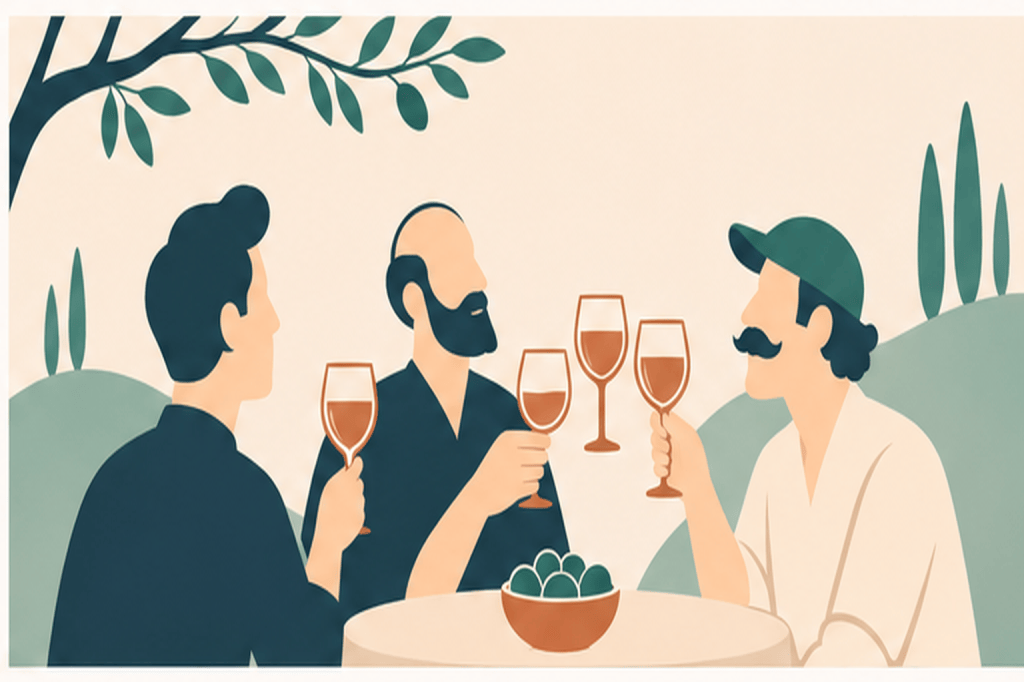
The Aperitivo
The sun had started its slow descent behind the hills of Umbria, casting long golden rays across the olive trees that lined the terrace. The air was warm, but not heavy. A late summer breeze moved gently through the vines crawling up the villa walls. Cicadas buzzed lazily. The villa, built from centuries-old stone, seemed to glow in the light.
Spada appeared first on the terrace, carrying a tray of glasses and a bottle of red wine — a Brunello di Montalcino, he announced with pride. You followed, having changed into a light linen shirt. Mr. RIP, already seated on one of the cushioned benches overlooking the valley, raised his hand in greeting.
There was something distinct about moments like this — the slow, unhurried pause before dinner, when the body relaxes and the mind opens.
“Three Italians on a terrace in Tuscany,” Spada said as he poured. “If we start talking about taxes, someone’s going to cry.”
Mr. RIP let out a laugh. “Not me. I emigrated.”
You smiled, taking the glass and leaning back. “Let’s try to enjoy the wine before we start the therapy session.”
There was a brief silence. The kind that comes not from awkwardness but from shared understanding. Then Spada leaned forward, resting his elbows on the table.
“Have you ever thought,” he said, “how hard it is for Italians to talk about money without guilt?”
You nodded slowly. “It’s either shame, or bravado. We swing between hiding it and flaunting it.”
Mr. RIP swirled his glass. “And rarely just… using it wisely. Growing up, no one ever said: ‘Make money so you can live better.’ It was more like: ‘Don’t talk about it. Just work hard.’”
“I think we’re all sons of that mindset,” you added. “The idea that investing is for the rich. That saving is virtuous, but planning is suspicious. That if you want to optimize your finances, you’re either greedy or you’re scheming.”
Spada nodded. “And yet here we are, each of us with a different path that took us out of that cage.”
The sun dipped further. A server brought out a plate of pecorino, olives, and thin slices of salame. Spada offered the first round.
Mr. RIP leaned back. “Switzerland changed me,” he said. “Not just for the obvious reasons. Yes, the taxes are better. The system works. But it’s more than that. The entire attitude toward money is different. They teach it in school. People talk about it without shame. Efficiency is not seen as soulless. It’s considered respectful.”
You sipped the wine. “In Italy, if you tell someone you invest in index funds, they either don’t know what it means or they think you’re some kind of trader.”
Spada chuckled. “Or worse, they ask you if it’s a good time to buy Eni.”
Laughter rippled between the three of you. But beneath it, the tension of truth lingered.
“I think about my parents sometimes,” you said. “They worked hard all their lives. Had no idea what a portfolio was. They trusted banks blindly. Bought government bonds because they felt ‘safe’. They had no concept of risk-adjusted returns or inflation. Just… trust and hope.”
Spada nodded solemnly. “Same here. My dad still thinks the BTP is the best investment on Earth. Because it paid well in 1985.”
Mr. RIP raised a finger. “And let’s not forget the culture of fear. ‘Better keep it in cash, or in real estate.’ How many people do you know who’ve parked their life savings into some half-finished apartment that’s been empty for a decade?”
You looked out over the valley. A few birds glided through the orange sky.
“Real estate is religion in Italy,” you said. “Tangible. Emotional. But also, illiquid and overvalued. Try explaining the 4% rule to someone who thinks their second apartment in the outskirts of Rome is their pension.”
Spada grinned. “I once tried to explain ETFs to my uncle. He said, ‘Ma perché vuoi complicarti la vita? Ti compri un garage, lo affitti, e sei a posto.’”
Mr. RIP laughed hard. “Classic.”
Then, more seriously: “But that’s the problem. People don’t want freedom. They want perceived certainty. And they confuse that with safety. The Italian mindset is about minimizing loss, not maximizing life.”
A quiet settled again.
You topped up the glasses. The sky was now streaked in deeper orange, with shadows stretching across the terrace.
“So what do we do?” you asked. “We figured it out. We invest, we optimize, we plan. But do we just walk away from the rest?”
Spada tilted his head. “Sometimes I think the real job isn’t just to build our wealth — it’s to translate this mindset. To help people see money not as something to fear or worship, but as something to use.”
“True,” Mr. RIP said. “But it’s hard. People associate wealth with luck or inheritance or corruption. Try to tell someone you got there through discipline and low-cost investing — they think you’re hiding something.”
You thought back to your own journey — the countless nights reading, learning, doubting. The fear of being wrong. The desire to not just earn, but understand.
“We need to talk more,” you said. “Share the stories. Normalize it. Not as a show-off move, but as a form of responsibility.”
Spada raised his glass. “To the mission.”
Mr. RIP clinked his. “To transparency.”
You smiled. “To freedom.”
The glasses rang gently, the way they do when they carry meaning.
As the sun finally slipped behind the hills, casting the terrace into twilight, the villa lights flickered on. A soft amber glow wrapped the three of you in warmth. You could hear faint voices from inside — the others gathering, maybe preparing for dinner.
Mr. RIP stood up, stretching. “Let’s go join them. Or else they’ll say the Italians are always late.”
Spada winked. “We were early. We just stopped for a longer aperitivo.”
You lingered a second, eyes on the valley below. In that moment, it wasn’t about net worths or FIRE goals or market cycles. It was about the quiet power of being surrounded by those who understood — not just the math, but the meaning.
As you followed your friends inside, a single thought lingered:
The difference isn’t in where we’re from. It’s in what we’re willing to question.
Leave a Reply