
Lunch, Logic, and the Life Well Lived
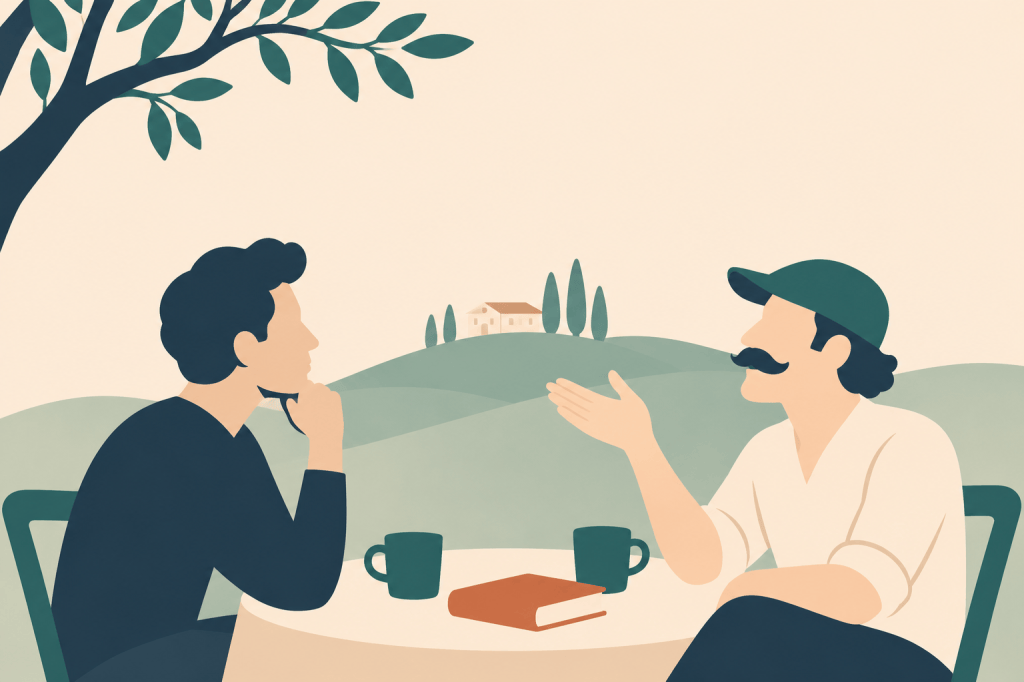
The bell rang from the old cast-iron triangle hanging on the olive tree. It was noon. Somewhere in the distance, laughter echoed through the vines. A few chairs scraped across stone. The long wooden table beneath the pergola had been set with care—ceramic plates, hand-woven linens, two open bottles of local red breathing slowly in the warm air.
I wasn’t there. Taleb and I had drifted down the cypress path toward the lake, absorbed in our own dense metaphysics of risk and freedom. But I later heard this story from the others at the table, especially from Maggiulli, who had narrated the whole affair like a Roman poet with a wine glass in hand.
“Ben started it,” he claimed. “Of course he did.”
Ben, as they tell it, placed his notebook gently on the table and turned toward Pete.
“So let me ask you something,” he said, almost apologetically. “You talk a lot about freedom. Time freedom. But you invest almost nothing. You’ve said before you don’t care what the market does.”
Pete smirked, chewing on a slice of grilled zucchini.
“You’re right. I don’t. The whole point of saving money was to not think about it anymore.”
Ben nodded politely, but his brow furrowed in that way only engineers and evidence-based investors can.
“But ignoring data doesn’t make it go away. If you’re in VTSAX or ITOT, you are in the market. You’re just choosing not to optimize. That’s fine if it’s intentional. But to not run the numbers at all—”
Pete cut in.
“Ben, I ran the numbers. Once. They told me I was free. So I closed the spreadsheet and went out to build a fence.”
A small laugh from the table. Spada leaned forward, clearly enjoying the spark. “Sounds like two monks arguing about how much water to fetch from the same well.”
But Pete wasn’t done. “You guys treat money like it’s a game to win. And I get it. You’re brilliant. You enjoy the optimization. But a lot of us just want out. Not out of the market—out of depending on it. I want my life back.”
Ben took a sip of water, thoughtful.
“I respect that. But to dismiss optimization entirely… that feels like rejecting a map because you already know the forest has trees.”
That landed harder than intended. Pete set down his fork.
“Ben, you’re optimizing a game I no longer want to play. I don’t want to ‘maximize utility.’ I want to minimize regret. And I’d rather regret having left money on the table than having wasted another year of my life chasing it.”
Silence, for a moment.
Maggiulli, who had been leaning on his elbow, broke the tension. “What if you’re both right?”
Everyone turned.
“Seriously. Felix is saying: know what you’re doing, or you’re flying blind. Pete’s saying: even if you’re flying, maybe you don’t want to go that far. Maybe a short flight to a quiet village is enough.”
Cederburg, who had been eating in near silence, finally looked up. “I’ll add something,” he said in a voice quiet but firm. “There’s empirical data that says we’re awful at predicting what makes us happy. So sometimes maximizing returns doesn’t maximize life. And sometimes minimizing regret leads you to avoid perfectly rational decisions. Behavioral traps work both ways.”
It was like a philosophical jazz trio. Felix nodded. Pete chuckled. Even Maggiulli looked impressed.
Then Mr. Money Mustache leaned back and, with a sweeping gesture, said: “You want a data point? Look around. We’re in a villa in Tuscany, talking about life and money and risk. No alarms, no meetings. That’s the real ROI.”
As if on cue, Christensen and Charley Ellis appeared at the end of the table.
Clayton was smiling softly, holding a small notebook of his own. Charley had a weathered paperback tucked under his arm and looked like he had just come from a nap, which he probably had.
“Mind if we join?” asked Charley.
“Please,” said Pete, motioning to the two empty seats.
Christensen took a seat next to Ben. “You look like you’ve been in the arena,” he said.
Ben smiled, a little sheepishly. “We were just debating the difference between optimizing wealth and optimizing life.”
Christensen nodded. “One of the great paradoxes of our age.”
Charley leaned in. “And one that gets easier with age. At some point, you stop chasing what doesn’t matter.”
Pete lifted his glass. “To that.”
The others joined in the toast, even Ben. The red wine sparkled in the sunlight that filtered through the vines.
Christensen looked at Ben with fatherly kindness.
“You know, I used to track everything. Calendars, goals, quarterly metrics. But when my daughter called me crying one night because I missed another recital, I realized I had been optimizing the wrong spreadsheet.”
He paused.
“Metrics are seductive. They give us the illusion of control. But life isn’t lived on a chart. It’s lived in moments like this.”
Ben looked down at his notebook.
“I understand,” he said. “But how do you know when to stop tracking?”
Charley answered this time.
“When the signal becomes noise. When the process starts to crowd out the purpose.”
Pete, still barefoot and now munching on a fig, nodded. “Amen.”
The conversation softened after that. The debate gave way to shared stories: Ben recounting how he once modeled a retirement drawdown strategy for his own parents. Pete describing the joy of building a tiny house with salvaged wood. Charley recalling how he once tried to beat the market in the 60s and ended up beating only himself.
Riccardo poured more wine. Cederburg offered data on why people who track their spending are actually happier—if they do it from curiosity, not anxiety. Maggiulli tried to settle a debate between Pete and Ben about what would happen to markets if everyone just held VT forever.
And through it all, the sun warmed the table, and the wind moved softly through the trees.
Eventually, Taleb and I returned, our shoes dusty from the trail, our minds spinning from an entirely different kind of walk. We saw the group from a distance—still at the table, some stretching out into the garden, others lounging on the steps of the villa.
“What did we miss?” I asked, as I approached.
Pete smiled. “Just a friendly disagreement about everything.”
Ben handed me a leftover fig. “And a few good answers hiding in plain sight.”
Christensen stood, stretched his back, and put a hand on my shoulder.
“Glad you’re back,” he said. “You might want to sit. We’re just getting started.”
And as I took my seat, glass refilled, notes waiting, I realized that this—this strange and wonderful gathering of minds and stories—was more than a retreat. It was a mirror. Not just of ideas, but of the choices we make, the people we become, and the peace we seek.
Leave a Reply