
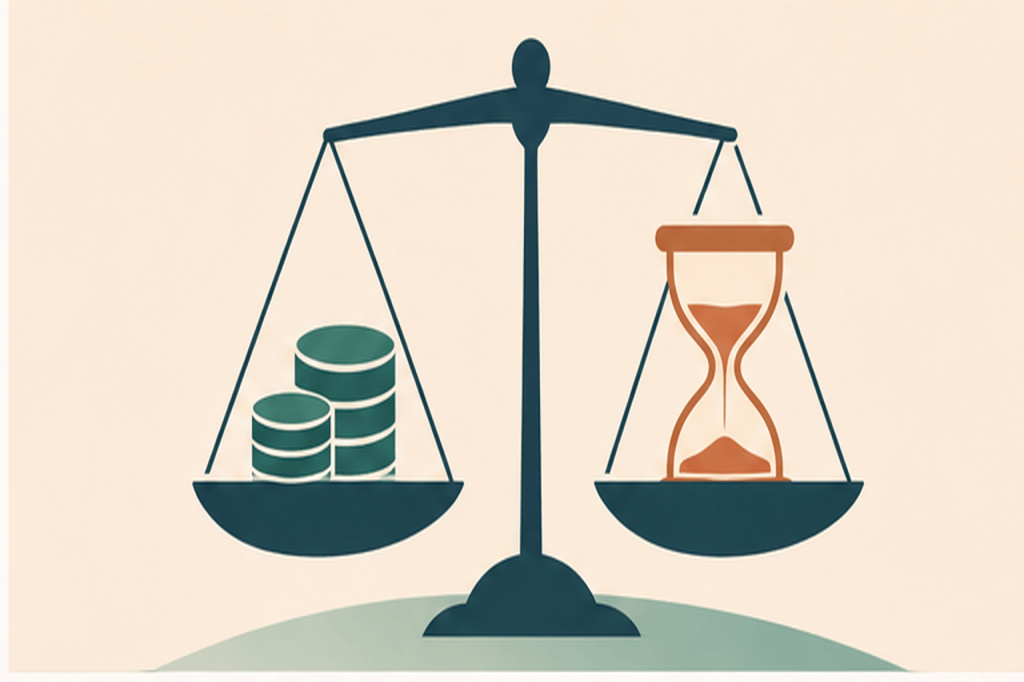
Money and time are often treated as two versions of the same resource. We exchange hours for wages, use savings to avoid future work, and measure the success of investments by the amount of wealth they accumulate. Yet the two resources behave differently. Money can be saved, invested, borrowed or, after a setback, sometimes earned again. Time passes regardless of what we do with it. That difference does not make money unimportant; it changes the purpose for which we might reasonably pursue it.
For someone struggling to cover rent or build an emergency reserve, money is genuinely scarce in the most immediate sense. It would be glib to suggest that a philosophical appreciation of time can substitute for financial stability. The relationship becomes more interesting once essential needs are reasonably secure. Additional wealth can still improve life, but the benefit of the next euro may be smaller than the benefit of having a free afternoon, a less demanding job or the flexibility to care for someone. Financial planning becomes more useful when it recognizes that these trade-offs change over a lifetime.
When Money Is the Binding Constraint
Early in an investing journey, the priorities are often practical. A household needs enough liquidity to absorb a surprise expense, manageable debt obligations and a margin between income and spending. Building that foundation takes effort and sometimes involves choices that are far from ideal. Working extra hours, moving for a better job or postponing a purchase can create financial resilience that did not previously exist. In this phase, pursuing more money may be the most direct way to protect time in the future.
The danger lies in assuming that the same approach should continue indefinitely. A strategy that made sense when savings were minimal can become less attractive once the household has substantial reserves. Extra work still produces income, but it may also displace family time, health, friendships or activities that cannot easily be postponed. The return on another hour of work should therefore be judged against what that hour would otherwise contain, not only against the additional amount deposited in an account.
Investing adds another layer to this exchange. Capital committed today may support future spending, but the outcome is uncertain and the waiting period has a cost. A person can save so aggressively for a distant future that present life becomes unnecessarily narrow. Another can spend so freely today that future choices remain permanently constrained. Neither extreme is solved by finding the perfect expected return. The more difficult task is deciding how much security is enough to justify the sacrifices required to obtain it.
The Hidden Cost of Later
Financial plans often assume that the future will resemble an extended version of the present. We imagine that the energy, relationships and interests available now will still be waiting when the portfolio reaches a chosen number. Some opportunities do survive postponement, but others are tied to a particular stage of life. Traveling with young children, spending time with aging parents or pursuing a physically demanding ambition may not be equally available twenty years later. This is not an argument against saving. It is a reminder that the timing of an experience can be part of its value.
The language of compounding can make delay sound universally virtuous. Money left invested for longer has more time to participate in returns, though those returns are never guaranteed. Experiences do not compound in precisely the same measurable way, yet they can influence relationships, memories and the direction of a life. A sensible plan makes room for both kinds of value. It may be rational to fund an important experience now while continuing to invest consistently, rather than treating every discretionary expense as a failure of discipline.
There is also an important asymmetry between money lost and time spent. A poor investment can sometimes recover, although it may not do so within the period that matters to its owner. A year consumed by work that no longer serves a purpose cannot be returned to the calendar. Recognizing this asymmetry should encourage better decisions, not anxiety about every passing day. Time is valuable partly because it is limited, but that does not mean every hour must be optimized or turned into a productivity project.
What It Means to Buy Back Time
The phrase “buying back time” can describe several different choices. A person might pay for a service that removes an unpleasant household task, accept a lower salary in exchange for a shorter commute or build a portfolio that eventually permits part-time work. These choices have different financial costs, but they share a common purpose: reducing obligations that consume attention without providing corresponding value. The appropriate decision depends on circumstances. Paying to outsource something you enjoy may make little sense, while paying to avoid a recurring source of stress can be worthwhile even if it reduces the amount invested that month.
An investment portfolio can create a more durable form of flexibility because it separates some future spending capacity from the need to work continuously. It does not provide freedom on a fixed schedule, and market declines can arrive at inconvenient moments. But gradually accumulated assets can change the consequences of saying no. A worker with sufficient reserves may be able to leave an unsuitable role, negotiate more confidently or take a period of unpaid leave. The portfolio is useful not merely because its market value is growing, but because it expands the range of choices available outside the market.
This is why simplicity deserves attention. Constantly comparing funds, reacting to forecasts and checking prices can consume the very time that investing was meant to protect. A coherent allocation, manageable number of holdings and a review process suited to real needs can reduce that burden. Simplicity is not a guarantee of superior returns, and it should not become an excuse to ignore risks. It is a way of keeping the management of money proportionate to the role money is supposed to play in life.
Enough Is a Personal Decision
The idea of “enough” is often misunderstood as settling for less than one could achieve. In practice it is a way to define what additional wealth is expected to accomplish. If a larger portfolio would finance a meaningful change in lifestyle, continued accumulation has a clear purpose. If it would mostly raise an arbitrary target without altering any planned choices, the case for further sacrifice becomes weaker. The same number can be enough for one household and inadequate for another because their commitments, aspirations and tolerance for uncertainty differ.
Enough is not necessarily a single permanent figure. Inflation, family responsibilities, health, housing and work can change the amount of financial support a life requires. It is better understood as a periodically revisited relationship between resources and priorities. A plan should include room for unpleasant surprises, but it need not assume that every possible future risk can be eliminated through additional saving. Pursuing complete certainty can itself become an expensive use of the present.
The question of money versus time therefore cannot be answered by declaring one universally more important. Their relative scarcity depends on circumstances, and each can protect the other. Money helps secure time by reducing dependence on income; time allows people to earn, learn, care, recover and enjoy the resources they have built. A thoughtful investment strategy recognizes that relationship rather than treating wealth accumulation as a contest with no finishing line.
The Life Behind the Portfolio
A useful way to evaluate financial progress is to ask what has become possible that was previously difficult. Can an unexpected expense be absorbed without panic? Can a holiday be taken without undermining essential commitments? Is there room to change jobs, support a relative or simply work fewer hours? These questions connect numbers to lived consequences. They also complement the broader discussion in How Investing Supports Your Ideal Lifestyle, where the portfolio is treated as an instrument for a chosen life rather than a goal in isolation.
The quiet achievement of investing is not necessarily reaching the largest possible account balance. It may be reaching a point where money occupies less of the day, because the foundations are strong enough that every decision no longer feels financially urgent. Getting there usually requires years of work, restraint and acceptance of uncertainty. Those efforts are worthwhile when they support something recognizable beyond the spreadsheet. Time cannot be stored for later use, but financial choices can help us use more of it deliberately while we have it.
Leave a Reply