
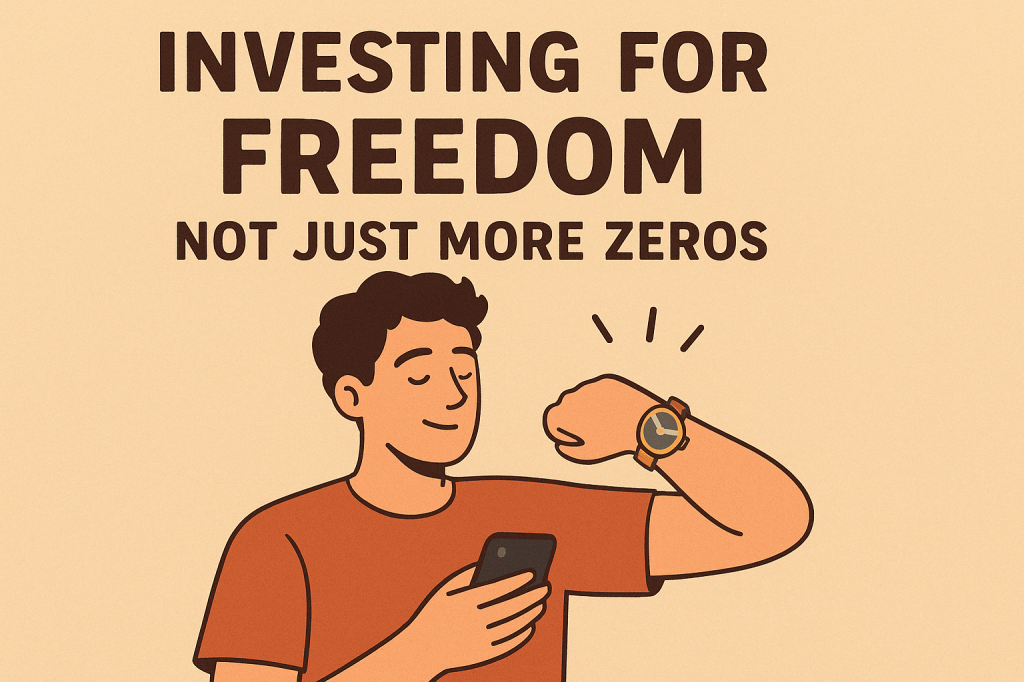
The most common measure of investment progress is a number. An account balance rises, a portfolio reaches a new high or a savings target moves from five figures to six. Numbers are useful because they make progress visible, but they can also become a substitute for asking why the money is being accumulated. A larger portfolio is not automatically a better life. Its value depends on the choices, security and opportunities that the additional resources make possible.
Investing for freedom begins by reversing the usual order of questions. Instead of asking how large a portfolio can become, the investor asks what kind of life it should support and what financial risks could prevent that life from being sustained. This does not require rejecting ambition, earning less or abandoning the pursuit of returns. It requires connecting financial decisions to purposes that exist outside the brokerage account.
The Moving Target of More
Accumulation is a necessary part of many financial plans. A household without reserves may need to save urgently, and a person preparing for retirement may require years of disciplined investment. The problem is not the desire for more resources. It arises when the target increases automatically each time it is reached, without any corresponding change in what the investor hopes to do. The portfolio becomes a scoreboard, and the sense of progress can fade even as wealth grows.
Social comparison reinforces this pattern. Stories of extraordinary returns, early retirement or conspicuous consumption can make a sensible plan feel inadequate. An investor who had enough to meet a meaningful goal may begin to take unnecessary risks simply because someone else has accumulated more. Such comparisons rarely account for differences in income, obligations, inheritance, risk tolerance or personal priorities. They create pressure without providing useful guidance.
A more durable approach gives each major financial goal a purpose. A reserve may protect against income interruption, a retirement portfolio may support future spending and a separate allocation may finance a planned change in work or housing. The targets can be revised as circumstances change, but they remain connected to identifiable needs. That connection makes it easier to distinguish progress from the endless pursuit of a larger number.
Freedom Is a Relationship Between Resources and Obligations
Financial freedom cannot be described adequately by wealth alone. Two households with similar assets may have very different degrees of flexibility because their spending, debt, dependents and employment situations differ. A person with manageable commitments and reliable income may be able to reduce working hours earlier than someone with a larger portfolio but substantial fixed obligations. The relationship between resources and required spending matters more than a universal threshold.
This is why controlling expenses can be as important as increasing investment returns. A lower level of unavoidable spending reduces the amount of income or portfolio withdrawals needed to maintain a lifestyle. Yet lower spending is not always better. Housing, healthcare, family support and experiences that genuinely improve life can be worth their cost. The objective is to remove expenses that create pressure without providing corresponding value, not to turn frugality into an identity.
Freedom also has a time dimension. A person may possess substantial assets but remain unable to leave a demanding job because commitments have grown alongside income. Another may have less wealth but enough flexibility to take a sabbatical, change careers or care for a relative. Those choices are concrete expressions of financial independence. The related article How Investing Supports Your Ideal Lifestyle develops this connection between portfolio design and everyday priorities.
Investing While Life Is Happening
Long-term investing requires postponing some spending, but life does not wait until the portfolio reaches its target. Certain experiences depend on health, relationships or a particular stage of life. A journey with young children, time spent with aging parents or the opportunity to pursue a physically demanding interest may not retain the same value if delayed for decades. Recognizing this does not justify ignoring future obligations. It means that the timing of spending can be part of a rational financial decision.
Bill Perkins’s Die With Zero challenges the assumption that maximizing the amount left at the end of life should be everyone’s objective. Its most useful contribution is the reminder that money is valuable because of what it enables while people are alive. That argument must be balanced against longevity, uncertainty and responsibilities to others. Some investors also find meaning in leaving an inheritance or supporting charitable causes. The appropriate balance is personal rather than a universal instruction to spend down every asset.
The tension between present experiences and future security is best managed deliberately. A household can set aside resources for meaningful activities while continuing to build long-term reserves and investments. The decision becomes easier when the portfolio has a clear purpose and when spending is evaluated against actual priorities rather than against the abstract goal of maximizing the final account balance.
A Portfolio Designed for Choice
A freedom-oriented portfolio should be constructed around the consequences of risk. Broad equity exposure may support long-term growth, but it can experience large declines and prolonged recoveries. Bonds, cash reserves and other instruments may help meet particular obligations or diversify sources of return, though they carry their own risks. The appropriate combination depends on when money will be needed and how much uncertainty the household can withstand.
Simplicity can support this approach by reducing unnecessary costs and decisions. A coherent portfolio with a manageable number of holdings may be easier to understand and maintain than a collection of overlapping strategies. But simplicity is not synonymous with safety: a concentrated portfolio can be simple and still be fragile. Each component should have a role that the investor can explain, whether that role is growth, liquidity, income or protection against a particular risk.
The ability to stay invested matters because a strategy that is repeatedly abandoned may fail to deliver the outcomes for which it was chosen. This does not mean never changing an allocation. A new family obligation, an approaching withdrawal or a shift in employment can justify reassessment. Discipline means responding to meaningful changes rather than to every market narrative. A plan that can be lived with is more useful than one that looks optimal only under assumptions its owner cannot tolerate.
What Enough Makes Possible
The concept of enough is not a fixed number or a command to stop working. It is a relationship between resources and the life a person wants to sustain. Someone may reach a point where additional saving would have little effect on daily choices, while another may need more capital to support dependents or manage uncertain income. Both can make reasonable decisions. The important step is to define what the next increment of wealth is expected to accomplish.
Financial progress can then be measured in ways that are less visible than account balances. A household may become able to absorb an emergency without borrowing, take a period of unpaid leave or refuse a role that would damage health or relationships. These are meaningful returns on years of saving, even though they do not appear as a line in a performance report. They illustrate why autonomy is a more useful destination than an endlessly rising target.
For Chill Capital, investing for freedom means treating money as an instrument rather than a scorecard. Returns matter, costs matter and risk management matters because they influence the resources available for real choices. But the portfolio should not consume the time and attention that it is meant to protect. Its deeper purpose is to make life less constrained, while leaving room to enjoy the present and prepare responsibly for an uncertain future.
Leave a Reply