
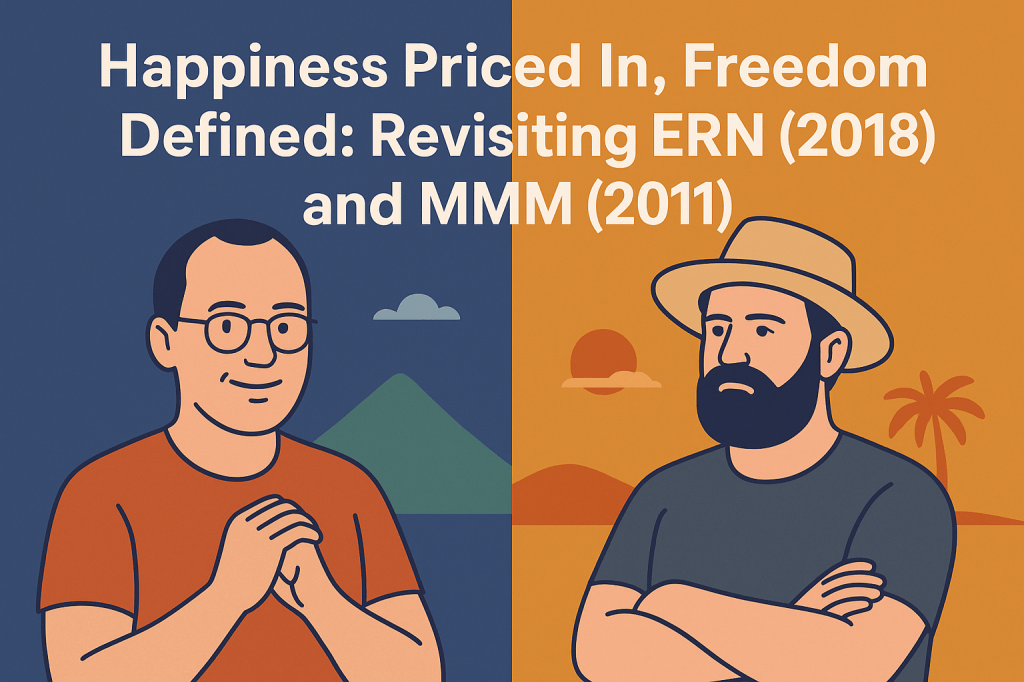
There’s a special kind of wisdom that only time can test. Some ideas age like fine wine, others like milk. In the world of financial independence and early retirement, the last fifteen years have given us enough of both to fill a cellar.
Two voices stand out in that chorus: Early Retirement Now (ERN), the numbers-driven yet unexpectedly introspective engineer who ran a now-legendary Safe Withdrawal Rate series, and Mr. Money Mustache (MMM), the carpenter-philosopher who built the cult of badass frugality in the early 2010s. A related Chill Capital perspective is explored in The Shockingly Simple Math Behind Early Retirement — Revisited.
In 2011, MMM wrote his seminal piece “What Does Early Retirement Mean Anyway?”—a manifesto that reframed retirement not as an escape from work but as the freedom to choose meaningful projects. Seven years later, in 2018, ERN published “Eight Lessons After Eight Weeks of Early Retirement,” a personal diary of the first days after walking away from a traditional career.
Looking back, we can put those two pieces of writing side by side. What did they see clearly? Where did they miss? And what can we learn when we look back not just at their words, but at how reality unfolded?
Lesson One: Happiness is Priced In
ERN’s most famous line from that 2018 post is short but profound:
“Happiness is priced in.”
What he meant was simple—by the time you reach the moment of retirement, you’ve already adjusted. The joy of leaving the office for the last time is not a thunderclap of bliss, but a slow drizzle that’s been falling for years. When he left, ERN realized that much of the happiness he had anticipated was already baked into the journey: the discipline, the planning, the security of knowing it was possible.
This is both comforting and unsettling. Comforting, because it means you don’t have to wait until the mythical “Day One” of retirement to feel relief. Unsettling, because if you think early retirement will suddenly make you euphoric, you might be disappointed.
Fast-forward to the 2020s. Research on well-being confirms what ERN intuited. Psychologists studying hedonic adaptation show that major life changes—whether buying a bigger house, winning the lottery, or quitting your job—rarely move the happiness needle for long. Our minds adjust. What matters is not the event itself, but the systems and daily rhythms that follow.
ERN’s insight looks almost prophetic now. It’s not the finish line that makes you happy. It’s the path.
Lesson Two: Redefining “Retirement” Before It Happens
Long before ERN logged off his employer’s VPN, MMM had already reframed the idea of retirement. In 2011, his essay posed a simple challenge: what does early retirement mean, anyway? For him, it wasn’t about sipping piña coladas or escaping all forms of labor. It was about never again being forced to trade time for money.
MMM kept building houses, riding bikes, writing blog posts. He was still working—sometimes harder than before—but it was work chosen freely. Retirement, in his view, wasn’t the absence of activity but the abundance of choice.
At the time, this was radical. The dominant narrative of retirement was binary: you worked until 65, then stopped. MMM smashed that wall down. Retirement, he said, could be an active state—one where money liberated you to say yes or no without fear.
In hindsight, MMM’s perspective was equally prescient. Many FIRE adherents in the 2020s report not “retiring” in the traditional sense at all. They start businesses, write books, volunteer, raise children more fully. The pandemic years accelerated this shift, as remote work blurred the line between employment and leisure. Early retirement today looks more like a fluid lifestyle than a permanent vacation.
Two Sides of the Same Coin
ERN’s “happiness is priced in” and MMM’s “retirement means freedom to choose” are not contradictions. They are two sides of the same coin.
ERN reminds us: don’t expect fireworks the day you quit. MMM reminds us: don’t expect to stop moving either. Put them together and you get a holistic truth: early retirement is less about escaping than evolving. You won’t suddenly become happier, but you can become freer. And with freedom comes the responsibility to shape your own days.
This combination—realism plus optimism—is what gives the FIRE philosophy staying power. ERN supplies the sobriety, MMM the exuberance. One tempers expectations, the other expands possibilities.
The Reality Check: Stories From the 2020s
What happened in the years after those posts proves the point.
Accounts of early retirement often return to a difficulty that spreadsheets cannot resolve: without the structure of paid work, some people discover that they need new projects, routines and relationships. The possibility of boredom does not discredit financial independence, but it does challenge the assumption that leaving a job automatically creates purpose. ERN’s reflections are valuable because they recognize the gap between anticipating a life change and actually living through it.
Social connection raises a related question. People may gain control of their schedules while losing the everyday contact that work once provided. Online discussions among early retirees frequently explore this adjustment, although individual stories cannot establish how common it is. MMM’s emphasis on purposeful activity offers one possible response: freedom becomes more meaningful when it supports relationships, learning and contribution.
Together, these stories highlight the dual wisdom: expect less from the finish line (ERN), and more from the freedom to create your next chapter (MMM).
Lessons for Today’s Reader
So what do we, in 2025, take from rereading these old posts?
A retirement plan should therefore address meaning as well as money. A sustainable withdrawal strategy matters, but so do interests, relationships and a reason to organize the day. The satisfaction of financial independence may also develop gradually rather than arrive as a dramatic reward on the final day of employment.
This does not mean everyone must keep working or join a community to enjoy retirement. Some people value solitude, others seek voluntary projects, and many move between different activities over time. The useful lesson is to design room for those choices before expecting a portfolio balance to supply them automatically.
A ChillCapital Take
From a ChillCapital perspective, the story is clear. Cash, compounding, and frugality matter. But the real dividend is psychological: peace of mind, agency, the ability to structure your life around joy rather than obligation.
ERN teaches us not to chase fireworks that won’t come. MMM teaches us not to wait for permission to live actively. Together, they show that financial independence isn’t a finish line at all—it’s an open horizon.
If you zoom out, this also explains why so many in the FIRE movement eventually circle back to the same word: balance. Balance between saving and spending, between frugality and enjoyment, between solitude and community. Financial independence is only as rich as the life you design once you have it.
Closing Thought
In 2011, MMM told us retirement means freedom. In 2018, ERN told us happiness is priced in. Both messages still hold up, but their true strength lies in their combination.
The freedom to choose, tempered by the wisdom not to expect miracles. The realism of hedonic adaptation, paired with the optimism of voluntary work. The reminder that money is only one form of wealth.
Early retirement is not the end of the story. It’s the prologue to the chapter you get to write yourself.
And maybe that’s the final lesson: you don’t retire to stop. You retire to begin.
Leave a Reply