
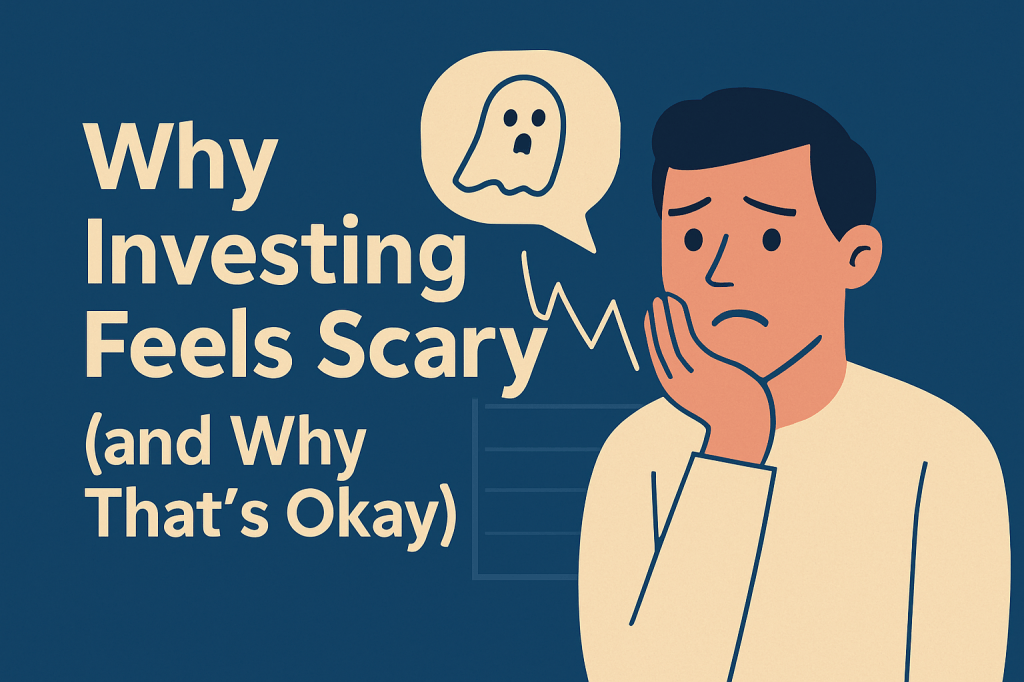
Investing can feel frightening even when a person understands why it may be useful. A household may have built savings carefully over many years, only to discover that buying a diversified equity fund means accepting the possibility of a substantial decline. The potential loss is not an abstract figure: it represents work, deferred spending and future plans. The fear is therefore not necessarily irrational. It can reflect the fact that money matters and that uncertain outcomes have consequences.
The difficulty begins when fear becomes the only basis for action. Someone may avoid investing entirely despite a long horizon and adequate reserves, leaving purchasing power exposed to inflation. Another may invest aggressively during a rising market, then sell after a decline because the emotional experience is more difficult than expected. Neither outcome can be explained simply by a lack of courage. The task is to understand which risks are real, which fears are amplified by the way information is presented and what kind of plan a person can reasonably sustain.
Uncertainty Is Not a Personal Failure
Human beings generally prefer outcomes they can anticipate, especially when essential resources are involved. Financial markets challenge that preference because prices respond to changing information and expectations. An investor can make a reasonable decision and still experience a loss. That gap between the quality of a decision and its eventual outcome can be unsettling for people accustomed to judging choices by whether they immediately succeed.
It is tempting to describe fear of investing as an ancient survival instinct misapplied to modern markets. Such explanations can be intuitive, but they risk turning a complicated psychological experience into a simplistic evolutionary story. Fear may arise from personal history, family responsibilities, prior financial losses or limited experience with uncertain assets. It may also be a sensible signal that the proposed investment exposes money needed for essential spending. Understanding the source of fear is more useful than dismissing it as a flaw in human wiring.
The distinction between risk capacity and risk tolerance is particularly important. Risk capacity concerns what losses a household can financially withstand, given its income, obligations and investment horizon. Risk tolerance concerns how comfortable the investor is with those possible outcomes. A person can have substantial capacity but little emotional tolerance, or feel comfortable taking risks that their finances cannot support. A workable allocation must account for both.
Loss Aversion and the Need for Reassurance
Behavioral research suggests that losses can carry greater psychological weight than comparable gains. This pattern, known as loss aversion, helps explain why a declining portfolio can provoke a stronger urge to act than an equally large increase. The effect varies across people and situations; it is not a universal rule that losses always feel exactly twice as painful as gains feel pleasurable. The underlying insight is that the emotional weight of a loss can change how an investor evaluates the same strategy.
Selling during a decline can provide immediate relief because it removes the possibility of further losses on the sold position. But it also changes the chance of participating in any subsequent recovery. An investor who waits for market conditions to feel reassuring may discover that prices have already risen by the time confidence returns. This pattern is possible rather than inevitable: markets can remain weak for long periods, and some assets never recover. The important question is whether the decision follows a change in financial needs or investment prospects, rather than simply a desire to stop feeling uncomfortable.
The relationship between loss aversion and investment decisions is examined in more detail in The Psychology of Loss Aversion. Understanding the concept does not make fear disappear, but it can help an investor recognize when a recent price movement is exerting more influence than the long-term plan warrants.
The Role of Headlines and Information
Financial news often emphasizes events that are dramatic, surprising or likely to attract attention. A sharp market decline can dominate coverage even when it does not alter a long-term investor’s immediate spending needs. Repeated exposure to urgent commentary may create the impression that every market movement requires a response. Yet much of the information relevant to a long-term allocation changes more slowly than the daily news cycle.
Avoiding all financial information is not the answer. Investors need to understand their holdings, costs, tax obligations and changes in personal circumstances. The useful distinction is between information that supports a decision and information that mainly intensifies a feeling. A quarterly review of allocation, liquidity and objectives may be more productive than checking prices several times each day. The appropriate schedule depends on the portfolio and household, but attention should be proportional to the decisions that genuinely need to be made.
Historical perspective can also help, provided it is not used to promise a recovery. Broad equity markets have experienced severe drawdowns and, in many historical periods, eventually recovered. That history supports realistic expectations about volatility, not certainty about the next decade. A person who needs money soon cannot rely on a distant average to pay a near-term bill. Understanding both the long-run opportunity and the possibility of unfavorable sequences is essential to making fear manageable.
Building a Plan That Can Withstand Discomfort
The first response to investing anxiety should be to examine the household’s financial foundations. Money needed for imminent expenses generally should not depend on favorable equity returns. An adequate reserve and manageable debt can reduce the likelihood that a temporary market decline forces an unwanted sale. These safeguards have costs, but they serve a different purpose from investments intended for long-term growth.
The portfolio itself should reflect realistic expectations. An investor who cannot tolerate a substantial decline may need a different allocation rather than repeated encouragement to become braver. Diversification can reduce dependence on a single company or market, but it does not eliminate losses. Bonds and other defensive assets have their own risks, and the appropriate mix depends on the timing of future obligations. A plan is more durable when its possible setbacks are understood before they occur.
Automation can make recurring contributions easier by reducing the need to decide when markets feel attractive. It does not guarantee favorable returns, and it should not continue unchanged if contributions become unaffordable. Written rules for review and rebalancing may help separate a genuine change in circumstances from an emotional reaction. The purpose of these tools is not to suppress judgment, but to reserve judgment for decisions that matter.
A Calmer Relationship With Risk
Fear can sometimes provide useful information. Persistent anxiety about a portfolio may reveal that the investor has taken more risk than expected, misunderstood an investment or failed to maintain sufficient liquidity. In those cases, reconsidering the plan can be appropriate. At other times, fear may simply reflect the discomfort of an uncertain but deliberate long-term strategy. The challenge is to distinguish these situations without treating every emotion as either an instruction or an enemy.
The goal is not to become indifferent to losses. Financial decisions involve real trade-offs, and it is reasonable to care about them. What matters is developing a process that allows the investor to respond thoughtfully rather than automatically. This may mean accepting a lower expected return in exchange for greater resilience, or maintaining a diversified growth allocation despite temporary discomfort because the household can afford the risk and the objective remains unchanged.
For Chill Capital, a calm investor is not someone who never feels afraid. It is someone whose financial plan makes room for uncertainty, whose obligations are matched to appropriate resources and whose decisions do not depend entirely on the emotional tone of the latest headline. Investing can remain uncomfortable at times without becoming chaotic. The purpose of preparation is to make that discomfort manageable while preserving the ability to pursue meaningful long-term goals.
Leave a Reply