
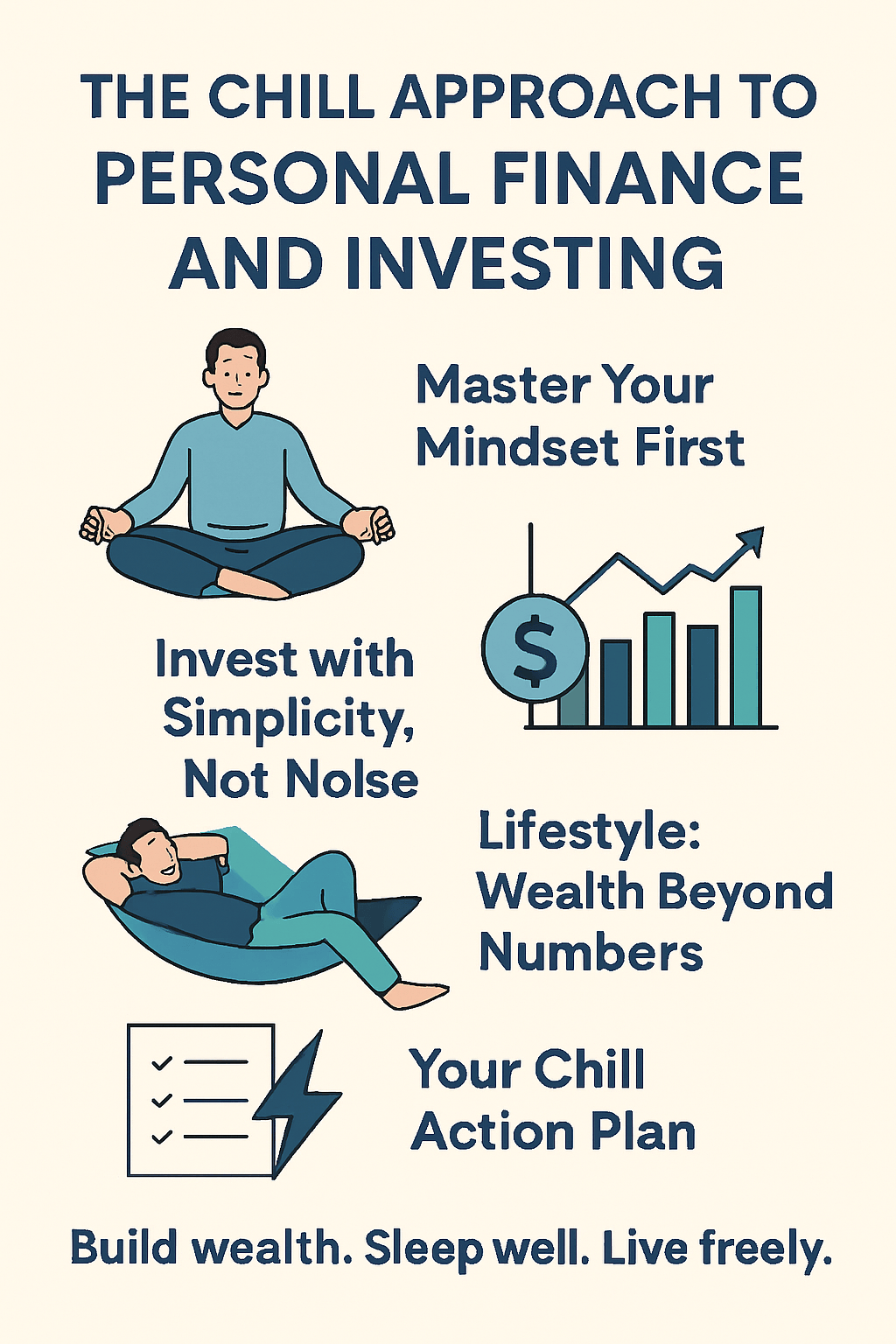
Personal finance is frequently presented as a contest between urgency and fear. One message insists that wealth requires extraordinary ambition, constant market research and the courage to pursue the next opportunity before everyone else discovers it. Another warns that investing is dangerous and that the safest response is to avoid uncertainty altogether. Both approaches can consume enormous amounts of attention. Chill Capital begins from a different question: how can financial decisions create security and choice without making money the central occupation of daily life?
A calmer approach is not a promise that investing will be comfortable or that markets will reward patience on a convenient schedule. Losses can be severe, income can be interrupted and even carefully designed plans can encounter circumstances they did not anticipate. The aim is to reduce avoidable fragility and unnecessary activity, while accepting the risks that are genuinely required to pursue long-term goals. Wealth becomes useful when it supports a life that the investor recognizes as worth living, not simply when the balance on a statement grows.
Financial Calm Begins Outside the Portfolio
The first foundation is the relationship between income, spending and obligations. A household that consistently spends everything it earns may have little room to absorb an unexpected expense, regardless of how promising its investments appear. Building a margin between income and spending can create reserves, reduce dependence on expensive borrowing and allow future investments to remain untouched during temporary difficulties. The size of that margin will depend on circumstances, and it is not equally easy for everyone to achieve.
Lifestyle inflation deserves attention because fixed commitments can expand quietly as earnings increase. A more expensive home, car or routine may bring genuine benefits, but it can also make the household more dependent on maintaining a particular salary. The important question is whether those expenses reflect priorities or have simply become the expected reward for earning more. Preserving some flexibility can create more choices than an impressive income accompanied by equally impressive obligations.
Cash reserves are sometimes dismissed as inefficient because they may earn less than risky investments over long periods. Yet a reserve has a different purpose. It can meet expenses when employment income is interrupted or when markets are unfavorable, reducing the likelihood of forced selling. Its value should be assessed against the household’s actual risks and needs, while acknowledging inflation and opportunity costs. The goal is not to maximize idle cash, but to keep short-term obligations from dictating long-term investment decisions.
A Portfolio You Can Explain
A simple portfolio is not necessarily a one-fund portfolio, nor is a complicated one automatically wrong. Simplicity means that the investor understands the purpose of each component, the main risks it introduces and the circumstances under which it may disappoint. Broad equity exposure can support long-term growth but may suffer deep drawdowns. Suitable bonds or cash instruments may help meet specific obligations, though their own risks depend on maturity, credit quality and currency. Other strategies can be justified when they add a genuinely different source of return or protection.
The temptation to add more products often comes from comparing recent performance. A sector that has risen sharply looks attractive, a fund that has lagged looks defective and a new strategy promises to solve whatever the portfolio currently lacks. These impressions may say more about the recent market environment than about the investor’s needs. Each addition should be assessed in the context of the whole portfolio rather than judged by its standalone historical chart. Costs, overlap, liquidity and behavior matter alongside expected returns.
Risk is not adequately summarized by a volatility number. A decline that is manageable for an investor with stable income and a long horizon can become a serious problem for someone who needs the money soon. Recovery time, access to capital and the possibility of forced decisions are central to the experience. This broader view is developed in How to Think About Risk Beyond Just Numbers. A portfolio should be designed for the owner’s circumstances rather than for an abstract investor who can tolerate every outcome.
Discipline Without Constant Attention
A long-term strategy requires maintenance, but maintenance is different from continuous intervention. Regular contributions, appropriate reserves and a periodic review process can help keep the financial system aligned with its purpose. When every market headline becomes a reason to reconsider the allocation, investing starts to resemble an exhausting second job. The investor may feel productive while creating costs and increasing the chance of emotional mistakes.
Automation can reduce friction for routine decisions. Scheduled transfers and purchases may make it easier to implement a saving plan without repeatedly guessing whether today is a good day to invest. Yet automation should not continue blindly when income or spending needs change. Similarly, rebalancing can help manage an intended risk allocation, but it involves costs and does not guarantee improved returns. These tools are valuable when they serve clear rules rather than becoming rituals performed for their own sake.
Patience is often praised as though it were an investment strategy in itself. It is not. Holding an unsuitable asset indefinitely does not become wise simply because the investor refuses to sell. The useful form of patience is the willingness to let a sound, understood strategy operate without unnecessary interference. That requires both confidence in the plan and the humility to revise it when genuine circumstances or evidence change.
Wealth Beyond the Account Balance
A financial plan becomes meaningful when it is connected to ordinary life. Having enough resources to leave a harmful work environment, spend time with family or take a period of rest may matter more than reaching a particular round number. These choices are not always available, and financial independence is not a binary state achieved on one date. It can emerge gradually as reserves grow, obligations become manageable and the consequences of saying no become less severe.
The idea of enough is useful here. It does not require abandoning ambition or refusing opportunities to earn more. It asks what additional wealth is expected to accomplish. If a larger portfolio would make a meaningful change possible, continued accumulation has a clear purpose. If the target increases automatically without altering any intended choice, saving can become detached from the life it was supposed to support. The relationship between time and money deserves regular reconsideration because health, family and priorities do not remain fixed.
Enjoying the present is not necessarily in conflict with preparing for the future. A household can invest consistently while deliberately spending on experiences, relationships and conveniences that provide real value. The trade-off becomes difficult when present consumption undermines essential security or when future accumulation consumes every opportunity available today. A coherent plan makes those trade-offs visible instead of assuming that either spending or saving is always the virtuous choice.
A More Durable Definition of Success
Markets will sometimes reward concentration, aggressive risk-taking and frequent changes of strategy. At other times those same choices will produce painful losses. A calm investor does not need to prove that a simple portfolio will outperform every alternative. The objective is to select a strategy that has a reasonable chance of meeting personal goals and can be maintained through a wide range of outcomes. That may mean accepting periods of underperformance relative to whatever happens to be fashionable.
Financial calm is also compatible with curiosity. Investors can study businesses, read research and examine new strategies without feeling obliged to trade on every interesting idea. Understanding the distinction between learning and acting is a valuable skill. An investment does not deserve a place in the portfolio merely because its story is compelling or its recent returns are strong. The burden of proof should rise when an addition makes the overall plan harder to understand or sustain.
For Chill Capital, building wealth without losing sleep is not about eliminating worry through a perfect asset allocation. It is about arranging money, obligations and investments so that ordinary uncertainty does not demand constant attention or threaten essential choices. The portfolio remains important, but it is not the purpose of the exercise. Its success is measured partly by the freedom it creates to spend more of life on things other than the portfolio itself.
Leave a Reply