
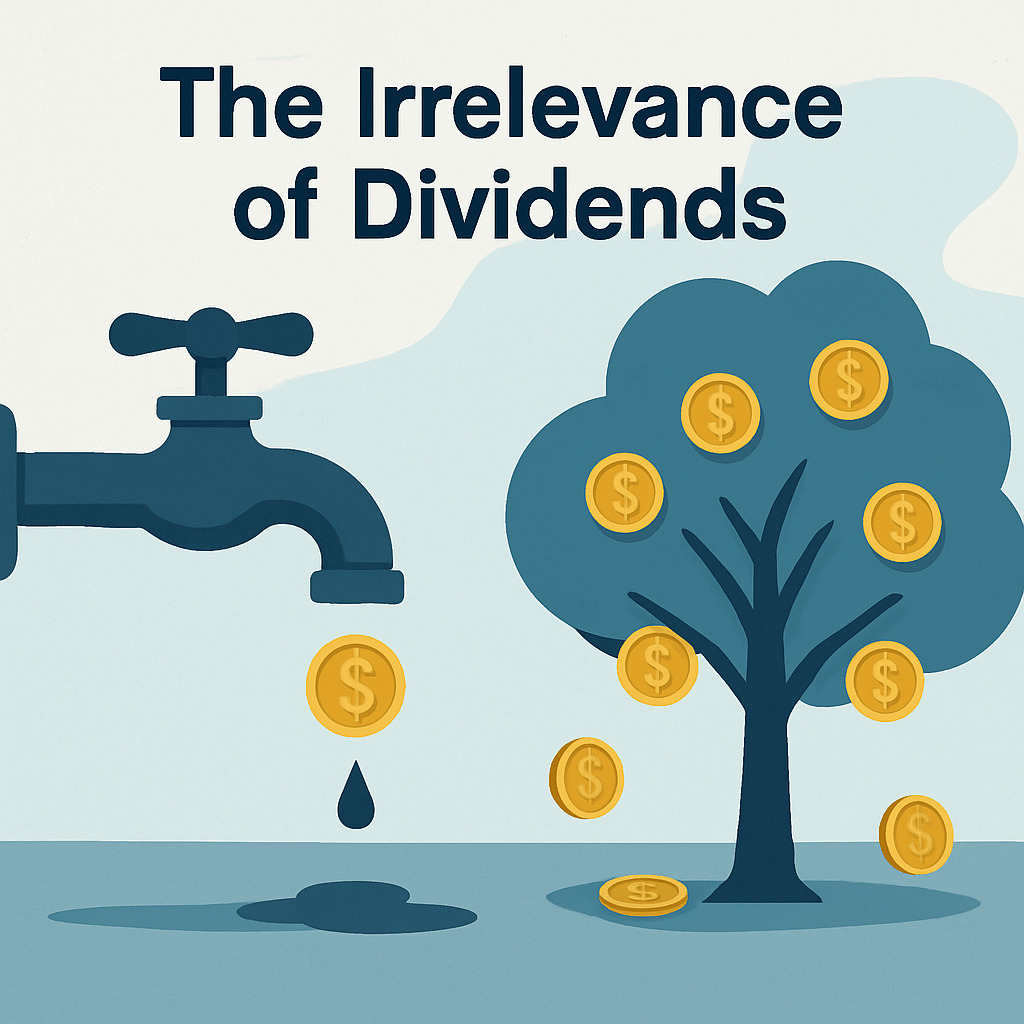
There is something unusually satisfying about receiving a dividend. A company transfers money into our account without requiring us to make a decision, sell an investment or interrupt the apparent continuity of our portfolio. The payment feels like a reward for patience, a tangible demonstration that the businesses we own are working on our behalf. For investors who associate financial independence with the ability to live from their assets, this experience can be especially powerful.
The appeal is understandable. Most of our financial lives are organized around recurring income. Salaries arrive at regular intervals, bills follow predictable schedules, and financial security is often imagined as the moment when income continues without the need to work. Dividends fit naturally into this mental framework. They transform ownership into something that resembles a paycheck, making investing feel less abstract than watching the value of an ETF fluctuate on a screen.
But the psychological attractiveness of a cash payment does not necessarily tell us anything about its economic value. A dividend is not money appearing from nowhere. It is capital leaving a company and entering the hands of its shareholders. Understanding this distinction changes the way we think about income, portfolio construction and the meaning of financial independence.
The important question is not whether dividends are good or bad. It is whether receiving cash automatically is more valuable than retaining the flexibility to decide when and how much cash to withdraw. Ben Felix develops this distinction between dividend payments and a total-return approach in The Relevance of Dividend Irrelevance.
What Actually Happens When a Company Pays a Dividend
A profitable company has several possible uses for the capital it generates. It can reinvest in existing operations, develop new products, acquire other businesses, reduce debt, repurchase shares or distribute money to shareholders. Each decision reflects an assessment of how that capital can be employed, and none is inherently superior under every circumstance.
A mature business with limited opportunities to reinvest at attractive returns may create value by returning excess cash to shareholders. A growing business with profitable expansion opportunities may be better served by retaining its earnings. The relevant consideration is not whether money is distributed, but whether management allocates capital intelligently.
When a company pays a dividend, its assets decrease by the amount distributed. All else being equal, the market value of the company adjusts to reflect that transfer. On the ex-dividend date, the share price typically adjusts downward by approximately the dividend amount, although ordinary market movements can obscure the relationship.
Imagine owning shares worth €10,000 immediately before a €300 dividend distribution. Ignoring taxes and market fluctuations, the investment might subsequently be worth approximately €9,700, while the investor holds €300 in cash. Total wealth remains €10,000. The investor has received liquidity, but has not become €300 wealthier simply because the payment occurred.
This does not mean dividends are economically meaningless. They can communicate information about a company’s financial position, impose discipline on management and provide a practical mechanism for distributing profits. What they do not do is create additional wealth independently of the underlying business.
The distinction is central to the dividend irrelevance argument developed by Merton Miller and Franco Modigliani in their 1961 paper, Dividend Policy, Growth, and the Valuation of Shares. Under idealized conditions without taxes, transaction costs or other market frictions, shareholders should be indifferent between receiving a dividend and obtaining equivalent cash by selling a small portion of their holdings. The company’s investment opportunities and underlying cash-generating capacity determine value, rather than the mere choice of how profits are distributed.
Real markets are more complicated than this theoretical framework. A broader review of payout-policy research by Franklin Allen and Roni Michaely examines how taxes, information asymmetries, transaction costs and other frictions change the analysis. Taxes differ, transaction costs exist, investors face behavioral constraints and corporate payout policies can convey useful signals. Nevertheless, the underlying insight remains valuable: cash received should not be confused with wealth created.
Why Selling Shares Is Not Necessarily Consuming Capital
Many investors resist the idea of financing spending through portfolio withdrawals because selling shares feels fundamentally different from receiving dividends. A dividend appears to preserve ownership, while a sale reduces the number of shares held. This creates the impression that dividends allow us to enjoy investment income without touching the capital itself.
Yet the number of shares is not a reliable measure of preserved wealth. What matters is the economic value of the remaining ownership and the cash already withdrawn.
An investor who receives a dividend owns the same number of shares in a company that now holds less cash. An investor who sells a small portion of an otherwise equivalent investment owns fewer shares, but each remaining share represents an interest in a company that has retained its capital. Under simplified conditions, the resulting wealth can be equivalent.
The difference becomes even clearer when we consider accumulating and distributing ETFs. A distributing fund transfers eligible income to investors, while an accumulating fund generally reinvests that income within the portfolio. Neither mechanism guarantees a higher total return. The investor’s outcome depends on the underlying investments, fund costs, taxation and how the distributions are used.
For someone seeking regular cash flow, a distributing fund can be convenient. It reduces the need to initiate withdrawals and provides a predictable operational routine, even if the amount distributed varies. An accumulating fund offers a different kind of convenience: income remains invested until the owner decides to access it.
The second approach allows withdrawals to be tailored to actual spending needs. Someone requiring €8,000 during a particular year can sell approximately that amount rather than depending on whether the portfolio happens to distribute €5,000 or €12,000. The investor controls the timing and size of the withdrawal, subject to market liquidity, taxes and transaction costs.
Of course, selling assets during a severe market decline can be psychologically difficult. Investors may feel they are permanently reducing their future participation in a recovery. But receiving dividends during a decline does not eliminate the economic consequences of withdrawing capital from a portfolio. It simply makes the withdrawal less visible.
A dividend payment may feel safer because no sell order appears on the screen. That feeling is real, but it should not be mistaken for an entirely different financial mechanism.
The Tax Consequences of Receiving Money Before You Need It
Taxation is one of the strongest reasons to distinguish between automatic distributions and discretionary withdrawals. The specific outcome depends on the investor’s country, account type, applicable tax treaties and the characteristics of the investment. There is no universal rule under which selling shares is always more efficient than receiving dividends.
Nevertheless, a recurring pattern appears in many tax systems: dividends may trigger taxation when they are distributed, while unrealized capital gains can often remain untaxed until a sale occurs. This difference gives the investor holding accumulating investments a degree of control over the timing of taxable events.
Consider a portfolio that produces €3,000 in annual distributions even though the owner has no immediate need for cash. If those distributions are taxable, part of the investment return may be lost to taxation before the remaining amount can be reinvested. An accumulating investment may allow more capital to remain invested, although fund-level withholding taxes and local tax rules can reduce or eliminate that advantage.
The distinction becomes particularly interesting when an investment has fallen below its purchase price.
In Italy, for example, ordinary taxable dividends on shares are generally subject to a 26% tax for individual investors outside a business activity, even when the market price of the shares has declined below the original purchase cost. Selling a position at a capital loss, by contrast, does not generate a taxable capital gain and may create a capital loss that can be offset against certain eligible future gains under the applicable rules.
This does not mean the two operations are interchangeable for tax purposes. Italian rules distinguish among categories of investment income, and losses from selling shares generally cannot be used to offset ordinary dividend income. The treatment of ETFs also differs from that of individual shares in important respects. These distinctions can materially affect the result.
The broader point is that a dividend can create a taxable event independently of whether the investor has made an overall profit on the position. A discretionary sale allows the investor to consider the relationship between market value, acquisition cost and the amount of cash required.
In other countries, the comparison may look different. Some jurisdictions offer preferential treatment for qualifying dividends, tax-advantaged investment accounts or specific rules for accumulating funds. Others impose taxes on deemed distributions or on investment returns even when cash is not received. An investor should therefore evaluate the actual tax treatment rather than assuming that one distribution policy is universally superior.
What remains conceptually important is the value of flexibility. Receiving money automatically can be convenient, but convenience may come with a tax cost when the investor would otherwise prefer to leave that money invested.
The Psychological Value of Dividends Is Not Imaginary
After examining the economic and fiscal arguments, it would be easy to conclude that dividend-focused investing is merely an emotional mistake. I think that conclusion would overlook an important aspect of real-world portfolio management.
Investors do not experience wealth as an abstract mathematical quantity. They experience uncertainty, regret, fear and the need for reassurance. A strategy that appears optimal in a spreadsheet may be ineffective if its owner cannot maintain it during difficult periods.
Regular dividends can provide a sense of continuity when market prices are volatile. They may encourage investors to focus on the operating performance of businesses rather than daily fluctuations in their share prices. For someone who finds selling shares emotionally distressing, an income-oriented portfolio may make long-term investing more sustainable.
That behavioral benefit deserves recognition.
The difficulty begins when psychological comfort becomes an excuse for ignoring economic reality. A company that pays a generous dividend is not necessarily financially stronger than one that retains its earnings. A high dividend yield can result from a falling share price, and distributions can be reduced or suspended when business conditions deteriorate.
Nor should a portfolio be considered safer simply because its income arrives automatically. A concentrated collection of dividend-paying companies may expose an investor to sector-specific risks, weak growth prospects or businesses whose payouts are increasingly difficult to sustain.
The desire for visible income can also influence asset allocation in ways that have little to do with long-term financial objectives. Investors may reject companies that reinvest profitably, prefer higher-yielding securities without adequately considering their risks or treat a dividend cut as a failure even when retaining cash would strengthen the business.
The central challenge is to separate the behavioral benefits of dividends from claims about their ability to generate superior returns.
If receiving distributions helps someone remain invested through difficult markets, that benefit may justify accepting certain inefficiencies. But it should be a conscious trade-off rather than a belief that dividends are an additional source of return unavailable to investors who hold accumulating assets.
Building Income Around Life Rather Than Around Yield
For me, the more useful starting point is not how much income a portfolio distributes, but how much liquidity the investor needs and when that liquidity must become available.
A person who is still accumulating wealth may have little reason to receive regular cash payments. If the objective is long-term capital growth, automatic distributions can introduce unnecessary reinvestment decisions and, depending on the tax environment, reduce efficiency.
Someone approaching retirement faces a different problem. The portfolio must eventually support spending, and the timing of withdrawals becomes important. In this situation, dividends can contribute to cash flow, but they need not determine the entire investment strategy.
A portfolio can be organized around future spending requirements through a combination of liquid reserves, bond maturities, distributions and planned asset sales. Each source of cash serves a different function. Predictable bond repayments may help cover expenses over a defined period, while growth assets can remain invested for longer-term needs. Dividends received along the way can reduce the amount that must be raised through other means.
This approach shifts attention from the label attached to a cash payment toward the reliability and timing of the underlying resources.
It also changes the way we think about risk. The most important question for someone living from a portfolio may not be whether the dividend yield reaches a particular percentage, but whether essential expenses can be funded without being forced to sell volatile assets at an unfavorable moment.
A portfolio with a high distribution yield can still suffer severe capital losses. Conversely, a portfolio with modest distributions may provide substantial financial flexibility if its liquidity structure is carefully designed.
There is no need to turn dividends into an ideological issue. They are one possible component of a broader financial system, not a substitute for that system.
Wealth Is More Than the Cash That Arrives
The popularity of dividend investing reveals something important about human behavior. We prefer financial outcomes that are visible, recurring and easy to interpret. A payment arriving in a bank account feels more concrete than an increase in the value of an investment, even when the economic result is similar.
That preference is understandable, but it can distort our assessment of wealth creation.
A company’s ability to generate and allocate capital matters more than whether it distributes that capital on a particular schedule. An investor’s total return matters more than the portion labeled as income. And the usefulness of a portfolio depends not only on what it earns, but on whether it can provide resources when those resources are needed.
I do not consider dividends inherently undesirable. They can be convenient, psychologically reassuring and entirely appropriate within a thoughtful investment strategy. What I question is the assumption that receiving a distribution is automatically preferable to retaining the ability to choose when to withdraw capital.
Financial independence is not necessarily the moment when dividends cover every expense. It is the moment when accumulated resources, investment structure and personal spending needs become sufficiently aligned that work is no longer required to sustain the life we want.
That freedom can be supported by dividends, planned sales, maturing bonds or a combination of different sources of liquidity. The mechanism matters, but it should not become more important than the objective.
A portfolio does not become more productive simply because it sends money to our bank account. Its value lies in the economic resources it represents and the choices those resources make possible. Once we understand that distinction, dividends can return to their proper place: useful when they serve a purpose, unnecessary when they do not, and never a substitute for understanding how wealth is actually created.
Leave a Reply