
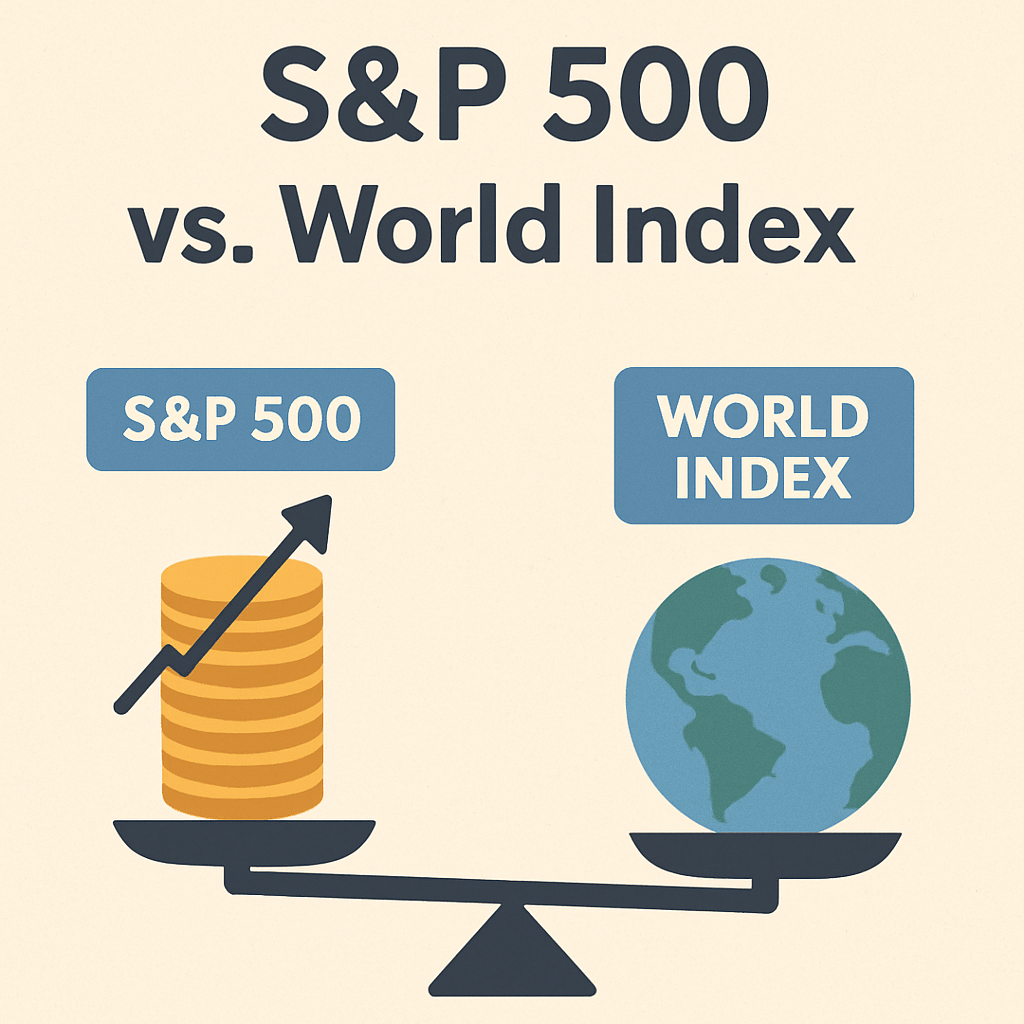
Choosing between the S&P 500 and a global equity index looks like one of the simplest decisions an investor can make. Both approaches offer low-cost access to hundreds of companies, both can be implemented through a single ETF, and both remove the need to select individual stocks. Yet the choice often generates surprisingly strong opinions, as though selecting one index over the other were a declaration about which part of the world deserves to win.
I have generally preferred the S&P 500. That preference comes partly from the structure of American capital markets, partly from the international reach of the companies included in the index, and partly from the simplicity of owning a collection of businesses whose economic importance is difficult to ignore. But a preference is not the same as proof of superiority. The more interesting question is not whether American equities have been successful, but what an investor is actually choosing to depend on when allocating capital to one market rather than the world.
A portfolio is never just a collection of securities. It is also a collection of assumptions about the future, and some of those assumptions remain invisible until circumstances begin to change. Vanguard’s October 2026 diversification research illustrates why the concentration of long-term wealth creation in a small number of stocks makes it difficult to know future winners beforehand. That finding supports broad stock ownership, but does not by itself settle the choice between a US-only and a global index.
Two Different Ways of Accepting Uncertainty
The S&P 500 represents approximately 500 leading publicly traded American companies. Its constituents operate across many industries, from technology and healthcare to financial services, industrial production and consumer goods. Many generate substantial revenues outside the United States, which means that buying the index provides exposure to businesses whose customers, suppliers and competitors are spread around the world.
This international reach is one of the strongest arguments in favor of the S&P 500. An American listing does not necessarily imply an exclusively American business. A company can manufacture in Asia, sell in Europe, develop technology in the United States and generate profits from dozens of different markets. The economic activity behind the index is therefore much more international than its geographical classification might suggest.
Nevertheless, international revenues and geographical diversification are not interchangeable. A multinational company remains subject to the valuation, regulatory environment, investor sentiment and capital-market structure associated with its home market. American companies may operate globally, but their share prices can still respond collectively to changes in US interest rates, domestic policy, market expectations or the relative attractiveness of American equities.
This distinction matters because diversification is not simply about where companies sell their products. It is also about where they are incorporated, how they are valued, which institutions govern them and what expectations investors have already embedded in their prices.
A global index approaches the problem differently. Rather than choosing a country believed to offer the most attractive businesses, it distributes capital across several equity markets according to a predetermined methodology. The MSCI World covers developed markets, while broader indices such as the FTSE All-World also include emerging markets. For an official example of a developed-and-emerging-markets benchmark, see the MSCI ACWI index methodology and profile. They are not identical products, and the distinction deserves attention when comparing them.
Global indices remain heavily exposed to the United States because American companies represent a substantial share of global stock-market capitalization. Consequently, choosing a world index does not mean abandoning American innovation or reducing it to an insignificant allocation. It means accepting the market’s evolving distribution of capital rather than deciding in advance that one country should remain dominant.
Neither approach eliminates uncertainty. The S&P 500 concentrates it within one equity market, albeit a large and internationally connected one. A world index distributes geographical exposure more broadly, while retaining the risks common to global equities. Both can experience severe drawdowns, both can become expensive, and both depend on the ability of businesses to generate profits that ultimately justify their valuations.
The difference is not between risk and safety. It is between two ways of deciding which risks are worth accepting.
Why American Equities Remain Attractive to Me
My preference for the S&P 500 has never depended solely on historical returns. Looking backward can explain why an investment became successful, but it cannot establish that the same outcome will repeat. The American market’s appeal comes instead from a combination of characteristics that have reinforced one another over time: deep capital markets, an established culture of entrepreneurship, access to investment capital and an economic environment in which successful businesses can expand internationally.
These characteristics have helped American companies become influential far beyond their domestic economy. The largest technology platforms, software providers, pharmaceutical businesses and consumer brands operate within networks that extend across national borders. Their competitive advantages often depend less on the growth of American consumption than on their ability to remain relevant to customers throughout the world.
There is also an institutional dimension. Investors benefit from relatively mature financial infrastructure, established reporting practices and highly liquid markets. None of these characteristics makes the United States immune to political mistakes, corporate failures or speculative excesses. They do, however, help explain why American equities have attracted so much global capital.
For an investor seeking simplicity, these considerations are meaningful. Owning the S&P 500 offers a straightforward way to participate in the economic results of many internationally important companies without constructing an elaborate portfolio. It requires relatively few decisions after the initial investment, and reducing the number of decisions can be a genuine advantage.
But this argument has a limit. A strong business is not automatically an attractive investment at every price. Investors can correctly identify a country’s economic strengths and still earn disappointing returns if those strengths were already reflected in exceptionally optimistic valuations.
The market does not reward us simply for owning successful companies. What matters is the relationship between the price paid, the profits eventually generated and the expectations that existed when the investment was made.
This is why the historical success of the S&P 500 should be treated as evidence of what happened, not as a permanent entitlement to future outperformance. American companies could remain exceptionally innovative while investors in other markets experience better returns. The two outcomes are not contradictory.
A global index offers a different response to this uncertainty. Instead of attempting to identify where future market leadership will emerge, it allows the geographical composition of the portfolio to evolve with market capitalizations. This approach is not free from concentration or valuation risk, but it reduces the need for a personal forecast about which country deserves a structural overweight.
There is considerable intellectual humility in that choice. It recognizes that future winners may emerge in places that currently appear less dynamic, and that markets can change leadership without asking investors for permission.
The Psychological Cost of Being Right About the Wrong Thing
The practical difference between these strategies becomes especially important when returns begin to diverge.
Imagine that American equities underperform international markets for an extended period. An investor holding a global index may find the experience frustrating, but the portfolio already contains exposure to the markets performing better. The geographical allocation adjusts gradually as relative market values change.
An investor concentrated in the S&P 500 faces a different psychological challenge. Continued underperformance may raise doubts about the original thesis. Was the preference for American companies justified by enduring structural advantages, or was it influenced by a period of exceptional returns? At what point does patience become attachment to an increasingly outdated assumption?
These questions cannot be answered through a simple rule about past performance. A decade of underperformance does not necessarily invalidate a strategy, just as a decade of outperformance does not prove that it was the best possible choice. Markets can remain out of favor for reasons unrelated to the long-term quality of the underlying businesses.
This is where personal conviction becomes both useful and dangerous.
Conviction can help an investor remain invested during difficult periods. A portfolio that makes sense to its owner is often easier to maintain than one assembled from fashionable recommendations. When prices decline, understanding why an investment was selected can prevent emotional decisions that turn temporary market losses into permanent mistakes.
Yet conviction can also become a justification for ignoring new information. The stronger our identification with a particular investment philosophy, the easier it becomes to interpret every favorable development as confirmation and every unfavorable development as temporary noise.
I do not believe that a world index is psychologically inferior because it contains businesses an investor cannot name. In fact, the opposite may be true. Its central advantage is precisely that it does not require us to form detailed opinions about every company or country. We accept that the market will continuously reassess their relative importance.
The psychological advantage of the S&P 500 is therefore personal rather than universal. I may find it easier to remain committed to a portfolio concentrated in American equities because I understand and appreciate the characteristics of that market. Another investor may find greater peace of mind in owning a broader representation of global capitalism.
Neither preference should be confused with an objective measure of financial sophistication.
There is also a less obvious problem with the idea of switching countries when the evidence changes. By the time another market has demonstrated sustained leadership, much of its outperformance may already have occurred. Moving capital after a long period of disappointing relative returns risks replacing a patient investment strategy with a recurring exercise in performance chasing.
If I choose the S&P 500 because I believe in its structural advantages, I must accept the possibility that those advantages will not translate into superior investment returns over my chosen horizon. Otherwise, the supposed long-term conviction is merely a short-term performance expectation wearing a more respectable name.
Choosing a Portfolio You Can Actually Live With
The most useful way to approach this decision is to separate three questions that are often mixed together.
The first concerns the businesses we want to own. American equities provide access to many internationally influential companies, while global indices extend ownership across a wider range of markets. The second concerns the risks we are willing to accept. Concentration in one country can create opportunities for outperformance but also increases dependence on a particular market’s future. The third concerns our behavior. A theoretically diversified portfolio offers limited protection if its owner abandons it whenever another market begins performing better.
For me, the S&P 500 remains an attractive core equity investment. I appreciate its simplicity, the global reach of its constituents and the characteristics of the market in which those companies operate. These are sufficient reasons to explain my preference, but they are not sufficient to claim that every investor should make the same choice.
A global index may be more appropriate for someone who wants to avoid making an explicit geographical bet. It can also be a more internally consistent solution for an investor whose philosophy is based on accepting uncertainty rather than attempting to anticipate which market will lead.
What I would avoid is turning the choice into a contest that must produce a permanent winner. An index is an investment instrument, not an identity. We should be able to examine its strengths and limitations without feeling that acknowledging a weakness somehow invalidates the original decision.
There is a broader lesson here that extends beyond the S&P 500 and world indices. Simplicity does not require certainty. A simple portfolio can still rest on complex assumptions, and diversification does not require us to predict where future prosperity will originate. The goal is not to construct an allocation that will look brilliant in every historical comparison, but to choose a structure whose limitations we understand well enough to tolerate.
I continue to favor American equities, while recognizing that this preference represents a deliberate concentration rather than a free improvement over global diversification. The distinction between the number of funds and the actual exposures inside them is explored further in Why Most People Overcomplicate Their Portfolio. That distinction matters because it keeps the decision intellectually honest. I am not claiming to know where the next generation of market winners will come from. I am choosing a particular exposure based on characteristics I value, while accepting that a broader global approach may prove more rewarding.
In the end, the most important difference between these two portfolios may not be their geographical composition. It may be the degree to which their owners understand what they have chosen, what they have given up and how they intend to behave when the future refuses to follow their expectations.
Leave a Reply